

#54 Dubious Détente
Plus: Rapper’s despair, fictitious fiscal ‘facts’, window pains, and more
Welcome to the 54th instalment of the Liberal Digest. It’s difficult to know where to start in a week in which the world’s most powerful man threatened: “A whole civilisation will die tonight, never to be brought back again.” In the end, of course, a truce of sorts was brokered. A fortnight of negotiations between Iran and the United States are now well under way, but with little indication that the two parties will be able to locate the fabled off ramp to more permanently de-escalate tensions. Closer to home, Sir Keir Starmer showed that the Government can act swiftly when it comes to controlling the nation’s borders, in a way, while Nigel Farage vowed to inflict retribution on nations who support reparations.
Did we miss something? Let us know. On X? Give us a follow.
Stop the Press!
Best op eds, interviews, news and analysis of the week in the old-school media
Bagehot questions the British state’s willingness to bar Kanye West from entering Britain:
“And so the British government faced an absurd question: should it block a rapper’s visa for three headline performances at Wireless Festival? In an act of uncharacteristic decisiveness, Sir Keir Starmer’s government did just that (the festival was promptly cancelled). In the process it created a rupture in British discourse, stranding topics on which Britain has forged a delicate compromise—freedom of speech, racism, mental health—at an absurd extreme. Britain is no stranger to blocking arrivals. Usually the victim is a no-name rapper or Islamist preacher, which causes little uproar. Occasionally, however, it is one of the biggest acts on the planet. Mr West’s permission was approved and then whisked away, demonstrating that the state would have been happy to host Mr West if his planned trip had caused less of a fuss. If Britain seems like a place where the home secretary can ban entry based on little more than a whim, it’s because she can; if it comes across as a country with weak protections of speech, it’s because it is. The treatment of Mr West reveals a casual, and inconsistent, authoritarianism in a country that paints itself as an inherently liberal one.”
Sir Sadiq Khan demanded tougher action against social media companies that fail to adequately counter disinformation:
“Over the past two years, posts related to London rose about 7 per cent overall while “London in decline” narratives increased up to 200 per cent, researchers found. Khan said social media companies should act to tackle falsehoods, including fake AI imagery. If they failed to do so, the state should intervene, he said. [...] Khan called for the creation of a new central body with “the agility and authority to protect our democracy from disinformation”. He also demanded “more aggressive enforcement of the rules we already have,” arguing that regulators like Ofcom needed more power.”
Ryan Bourne shows how the evidence on minimum wage hikes points to consequences borne by low-wage workers themselves:
“Last week the national living wage rose again, to £12.71 an hour, given the government’s two-thirds-of-median-earnings target. Yet the LPC’s latest report, focused on the 2025 uplift, shows many harms beyond the simple employment effects, several of which hurt low-wage workers themselves. The report depicts an ossified “low-hire, low-fire” labour market, in which companies most exposed to the wage floor have faced “weaker employment growth”, employers have cut recruitment and staff hours in response to the rise, and average hours for minimum wage workers remain below pre-pandemic levels. This is where modern evidence shows how high minimum wages bite. Not through mass sackings, but slower hiring, weaker workforce attachment and fewer entry-level opportunities. Young people, who rely on first jobs to gain a foothold, suffer disproportionately, compounded now by Labour’s compression of special youth rates towards the national minimum.”
Stephen Bush says politicians who castigate companies for ‘profiteering’ are spouting nonsensical and unhelpful rhetoric:
“We should worry that so few politicians in the UK and other democracies are willing or able to articulate a defence of the best method yet devised for allocating scarce resources — free markets and consumer choices. Not to mention the best method yet devised for protecting the losers from that process — cash transfers to the poorest and most vulnerable. Instead they want to reach for approaches that already we know don’t work. Some mainstream politicians may be reluctant to argue for market mechanisms because they don’t believe in them. But the other reason, more insidious and more dangerous because it is more widespread, is that arguing for market mechanisms to respond to the energy crisis is harder if you don’t have the fiscal firepower, the political capital or both to compensate the most vulnerable losers.”
Janan Ganesh lays out the madness of the Madman Theory:
“The wonder is that Madman Theory is still discussed with a straight face. Nixon practised it about as well as possible — working in secret, threatening a country of little global significance — and still achieved next to nothing. To the extent that he did go feral, bombing Cambodia and Laos, it sullied the US more than it forced concessions from the other side. There is a desperation out there to see cunning and forethought in Trump’s wildest behaviour. This has skewed financial markets, which were too optimistic at the start of the war, and in Lagarde’s view still are. If something good is to come of the present chaos, it might be a new realism about the US leader. Even if Trump does have a strategy that can be called Madman Theory, that doesn’t mean it is a good one. It just means that he has a weird reading of the past. Four years after the Oval Office conversation between Nixon and Kissinger, the North Vietnamese took Saigon. Of the 58,220 US deaths in the war, over 20,000 occurred under the genius pair.”
As many as 90 Labour Members of Parliament are planning to rebel against David Lammy’s reforms to jury trials:
“The bill would create judge-only trials for about half of those heard by juries at present in an attempt to cut the backlog in the crown courts, which stands at a record 80,000-plus cases. The judge-only trials would be for a range of offences that attract prison sentences of up to three years. The amendment has been put forward for consideration by a committee of MPs, but supporters have made clear that they will force a vote in the Commons if the government does not back down. It is seen as the main route to “kill off” and defeat the controversial jury trials reforms, a separate source told the Times. It is in the name of Charlotte Nichols, the MP who has accused the government of “weaponising” rape victims to justify the changes.”
OpenAI put its flagship UK data centre project on hold, blaming high energy costs and policy decision over copyright:
“OpenAI said that concerns about the UK government’s AI policy, in particular a decision to delay contentious changes that would have made it easier for AI companies to include copyrighted content in their training data, contributed to the delay. “We continue to explore Stargate UK and will move forward when the right conditions such as regulation and the cost of energy enable long-term infrastructure investment,” OpenAI said.”
Tom Harwood untangles the litany of rules that keep Britain’s windows small:
“England’s Part B building regulations squeeze windows, since large openings near boundaries count against fire-spread limits. Part K makes generous low-sill openings fussier and pricier through fall-protection requirements. And then Part O caps glazing by orientation and ventilation type, and layers on tougher anti-fall rules, meaning smaller openings, all in the name of preventing overheating. But beyond the alphabet soup of building regulations, it is a British Standard rule that the Royal Fine Art Commission Trust highlighted in the case of our dark, stunted, half a million quid Littlehampton property: As the University of Edinburgh notes “clause 8 of the standard recommends that windows should be cleanable from inside by 95 per cent of the elderly female population, without the need for stretching.” Yes, seriously. If a little old lady can’t reach the top of the window, you shouldn’t build it. Pokey prison-windows to placate our gerontocracy. Or perhaps an imagined idea of our gerontocracy. Can the “elderly female population” not make do with the time honoured idea of a cloth on a stick?”
Aiden Abbott: The agonising death of liberal atheism
Sonia Sodha: Don’t be fooled, fringe parties are still wacky
The Guardian: Ministers unveil ‘right to try’ plan to help disabled people find work
City A.M.: OECD tells Reeves to reform ‘inefficient’ UK tax system
BBC: Artemis II crew head for home after travelling further from Earth than anyone before
Financial Times: Scaled-back digital ID scheme can combat populism, UK minister says
The Guardian: Commonwealth leaders vow to keep seeking reparations after Reform UK plan to halt visas
The Economist: Why can’t Britain pass an assisted-dying bill?
Stacks of Freedom
Highlights from our fellow Substackers
Michael Hill urgers greater devolution of power to Mayors, to allow British cities to catch up with their twins on the continent:
Alex Mayyasi considers what the policy implications should be in a world plagued by ‘cost disease’:

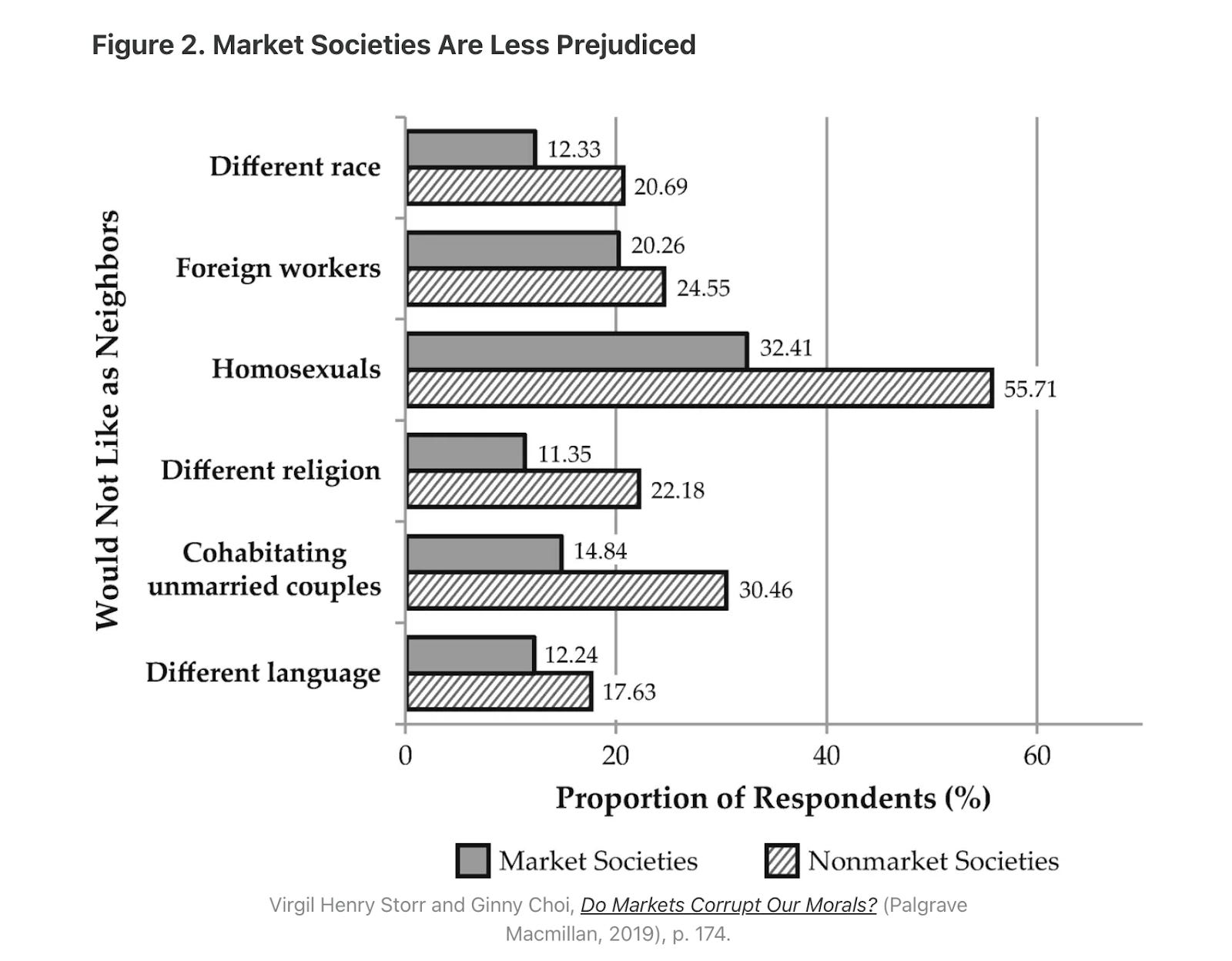
Walker Wright has the receipts on how open economies lead to open minds:

Brink Lindsey argues that the progress movement needs a better theory of progress:

Harry Richer shows how the numbers the Chancellor reads out are fiction:

Kristian Niemietz writes in defence of New Towns:

Tibor Rutar reminds us that the likelihood of democracy in a well-developed nation collapsing remains low:

Matt Clancy explains why even miniscule uplifts in progress can have huge consequences:

Wonk World
Ideas and analysis from the think tanks, academia and other clever sorts
A new research paper suggests that the spread of gig work in France led to a reduction in criminal activity:
“Overall recorded crime falls by around 3% after platform entry, with violence against the person down nearly 7%. The largest declines are in vandalism and destruction of property (−15%, Panel a) and drug offences (−15%, Panel b). The fall in vandalism is particularly consistent with the incapacitation channel. These offences are disproportionately committed by adolescents and young adults and tend to be concentrated in the evening and weekend hours that delivery shifts occupy. The reduction in drug offences aligns more closely with income substitution: platform work provides a legal, accessible alternative to low-level dealing for individuals facing barriers to formal employment.”
Hear Hear
Podcasts for weekend listening
The good folks at Works in Progress discussed a batch of articles featuring in their upcoming issue:

Posting to Policy
Best of social media this week


Via Joseph Gellman
Further Afield
Interesting stuff from around the world
The United States and Iran agreed to a two-week ceasefire, though it is already coming under strain:
“Iran has agreed to allow vessels through the Hormuz Strait for two weeks, with their passage coordinated by the Iranian military. The country has also issued a 10-point plan, which includes, among other things, the complete cessation of war in Iran, Iraq, Lebanon and Yemen; “full commitment” to lifting sanctions on Iran; the release of Iranian funds and frozen assets held by the US; and a “full payment of compensation for reconstruction costs” to Iran. It also says, “Iran fully commits to not seeking possession of any nuclear weapons”. “Iran’s victory in the field would also be consolidated in political negotiations,” Tehran’s Supreme National Security Council said in a statement. According to Sharif, the ceasefire will also take effect in Lebanon, where Israel has been fighting the Iranian-backed armed group Hezbollah. Israel has backed the deal but says it “does not include Lebanon”, renewing strikes on Wednesday in the Tyre and Nabatieh areas in the south of the country. Trump’s press secretary Karoline Leavitt later also said that Lebanon was not included in the deal.”
Xi Jinping ousted another Politburo member, continuing his purge of China’s political elite:
“Ma Xingrui, the top official in China’s far-western region of Xinjiang from late 2021 to July last year, has been placed under investigation on suspicion of severe violations of party discipline and state laws, according to a brief statement issued by the party’s top internal watchdog on Friday. The statement didn’t elaborate on Ma’s alleged wrongdoing. Ma, 66, couldn’t be reached for comment. Beijing ousted two other Politburo members, both senior generals who were Xi’s top military deputies, in October and January. The probe against Ma marks the first time the party has purged more than two Politburo members in the same term of office since the Mao Zedong era.”
Vice President JD Vance visited Hungary to endorse Viktor Orbán in their forthcoming election, in which he attacked the European Union over alleged electoral interference:
“After winning four elections in a row since 2010, Orbán faces the toughest challenge in a political career going back almost 40 years. In a last-ditch bid to boost the prime minister before the 12 April vote, Vance and his wife Usha arrived in Budapest for the first top-level US visit to Hungary for 20 years. They were welcomed by Foreign Minister Péter Szijjártó, who said Orbán’s friendship with President Donald Trump had created a “new golden age” in relations. Péter Magyar responded to the visit by saying his Tisza party welcomed Vance to Budapest, and that when his party came to office it would consider the US as a prominent partner, both as a Nato ally and as an economic partner. Following talks with Orbán, Vance launched a bitter attack on the European Union and Ukraine.”
The Financial Times report on how Flávio Bolsonaro is plotting to emulate his father Jair:
“To appeal to the centre ground, Bolsonaro is emphasising his reputation as the more moderate member of the family. A lawyer who once owned a chocolate shop, his tone is less abrasive and confrontational than his father’s. As president, Jair Bolsonaro was famously sceptical about Covid-19 vaccines; Flávio Bolsonaro publicly took the jab. However, the platform is similar to that of his father: a mixture of far-right positions on social issues and crime with centre-right views on the economy and a fervent belief that Bolsonaro senior was unjustly convicted. Flávio Bolsonaro, who spoke last weekend at the conservative CPAC conference in Dallas, told the FT Lula was too hostile to the US and too favourable to China. “President Lula is wrong to close the door to the United States and simply open Brazil up as if it were a Chinese colony,” he said. Flávio Bolsonaro visited El Salvador last year to observe President Nayib Bukele’s controversial policy of mass incarceration. He wants something similar in Brazil, with 16-year-olds charged as adults and the age limit lowered to 14 for crimes such as murder and rape.”
CNN: Cuba to free more than 2,000 prisoners as economic crisis deepens under US pressure
POLITICO: Was Trump’s threat to end Iran’s civilization a war crime?
Washington Post: new data from Argentina shows the real answer to poverty
The Guardian: The deadliest 10 minutes in decades: Lebanese reel from Israeli strikes that killed hundreds
The Economist: There is little prospect of legalising abortion in Brazil
Reuters: China will not tolerate independence for Taiwan, Xi tells island’s opposition leader
Graph of the Week
Via Walker Wright