

#55 Hungry for Change
Plus: Enticing expats, growth mindsets, advocating for anonymity, and more
Welcome to the 55th instalment of the Liberal Digest. Hungary’s illiberal prime minister, Viktor Orbán, was removed after 16 years in office in national elections this week, making way for new PM Péter Magyar, a former ally of Orban’s and a move that suggests a pivot away from Vladimir Putin and towards the European Union for Hungary. Elsewhere, Donald Trump got into a war of words with Pope Leo, and, closer to home, Peter Mandelson is firmly back on the agenda as yet more questions over his vetting process pile yet more pressure on Sir Keir Starmer. Meanwhile the local election campaigns are in full flow now, and there is a depressing amount of fantasy economic policies coming from a range of sources — this week it was the turn of the Scottish National Party who have pledged price caps on ‘essential foods’ in the supermarket. Let’s see how that one goes…
Did we miss something? Let us know. On X? Give us a follow.
Stop the Press!
Best op eds, interviews, news and analysis of the week in the old-school media
Paul Swinney vowed to legally cap the cost of specific items of food in Scotland:
“The first minister told the event that the cap would apply to “everyday items that make up a decent diet”, such as bread, milk, cheese, eggs, rice and chicken in large supermarkets. The SNP manifesto, external says the price of between 20 and 50 items would be limited. Supermarkets would be required to cap the cost of at least one variation of the listed items, such as one particular brand of bread, but would not have to cap the prices of all their bread brands. [...] It is not clear precisely how the shopping price cap would be enforced, though the manifesto says it would be introduced as a public health measure, similar to the minimum unit price of alcohol. The document urges the UK government not to block the proposal under the Internal Market Act, which is designed to ensure shared trading standards across the UK.”
Sam Richards argues that OpenAI’s rethink on building data centres in Britain is no surprise considering our sky-high energy costs:
“Buying lots of offshore wind in 2021 made sense at £57/MWh. But the latest deals cost nearly double that. In trying to avoid volatility, the government has plumped for the false security of a record amount of the most expensive wind power in a decade. Wind farms also require more grid than a smaller number of nuclear power plants, both for themselves and for the back-up gas they rely on, the cost of which is loaded onto bills. Even if wind gets cheaper through planning reform, a grid dominated by it faces a core challenge: the wind doesn’t always blow, which leads you back to burning gas. While more wind means we burn less gas overall — handy when prices spike — the trade-off is the cost of building the system twice: once for wind and once for the gas back-up. And if gas plants run intermittently, their economics get much worse. So the energy we have built has been subsidised, with costs loaded onto industry through energy bills, making industrial electricity more expensive than it is for our competitors. Industrial consumers in Britain pay around £61/MWh in levies; in France, they pay just £2/MWh. Germans pay more, but still only £10/MWh. British steel competes with French steel while paying thirty times more in policy costs per unit of electricity.”
Rachel Reeves was urged by the International Monetary Fund to avoid a big energy support package for households:
“Since late February, government bond yields across advanced economies have risen noticeably. But as the IMF noted, increases in UK borrowing costs had been particularly sharp. This reflects in part higher inflation expectations and speculation that interest rates will have to rise. In a £15bn debt syndication on Tuesday, the UK paid a yield of slightly more than 4.91 per cent, the highest in any 10-year debt sale since 2008. Asked why UK government bond prices had been so volatile following the war, Valdés said it was a question for financial markets. The country’s “consolidation plan is good” and its declared strategy in the face of surging energy costs was “the appropriate response”, he said. Any measures to alleviate the impact needed to be within the fiscal “guardrails” that Reeves has set out as she attempts to deliver a current budget surplus later in the parliament, Valdés added.
Legislation will be brought forward to allow the United Kingdom to more rapidly align with European rulemaking:
“In most cases they will be adopted by so-called Henry VIII powers, secondary legislation through which parliament cannot amend regulations and where they are usually simply rubber-stamped. The bill, first revealed by the FT last month, has been attacked by politicians on the right, who until now have been reluctant to refight Brexit battles: polls show that Britain’s exit from the EU is now unpopular with voters. But Starmer told BBC Radio 5 Live on Monday: “We have got to look forward, not backwards. Let’s not have all the old arguments of the last decade. “We are trying to make trade easier so there are less burdens for business and that translates into lower prices.” Starmer insisted that Britain needed closer commercial and security ties with Europe in an era of “great uncertainty”.”
David Gauke explains why he doubts Reform will manage to meaningfully change the economic dial:
“Given that Nigel Farage is on record at having praised the economic policies of both Liz Truss and Jeremy Corbyn, it is a little optimistic to expect as Prime Minister he would demonstrate intellectual rigour and coherence on economic policy. Nor when we look at other examples of populist governments – Donald Trump in the US, Boris Johnson here – is there any reassurance of a well thought through policy agenda. The same could be said for political bravery. Farage, by temperament, is (like Trump and Johnson) all about pleasing his base. As for the attitude to institutions and the rule of law, populists advocate a world in which strongmen can act unconstrained. This creates uncertainty and instability that is loathed by business and investors which, in turn, makes growth harder. Then there is the voter base. Reform UK’s support is very narrow – based on older, less educated voters. If the party achieves the support of 15 per cent of AB voters, it will be doing well. For all the hope of bringing renewed dynamism to the British economy, Reform UK will not have assembled a pro-growth electoral coalition. A parallel can be drawn with Brexit. There is an arguable case that Brexit enabled a bold Singapore-upon-Thames growth strategy, but such an agenda was never pursued. Why not? It would have been impossible to sell to the coalition of voters who backed Leave.”
Chris Snowdon mounts a defense of liberalism, against its defenders:
“To Wooldridge, free market economists and book-burning BLM grifters are both the same insofar as they are the bastard offspring of real liberals and have ruined it for sensible centrists by taking things too far. The comparison is unfair. Woke liberals, abetted by managerial liberals, have given us men in women’s sport, legalised racial discrimination, censorship, defund the police, de facto open borders and Nish Kumar. Economic liberals have given us Facebook and Uber. The early neoliberals used economic logic to explain why Bolshevism would fail. After 1945, they spent years in the wilderness warning that Keynesianism would also fail. They were right both times. Their teachings helped to control inflation for decades until governments unlearned the lessons during the pandemic. Their arguments against tariffs, protectionism, rent controls, nationalisation and over-regulation are timeless even if they need to be re-learnt every few generations. Economists will always face the trite accusation that they know the price of everything and the value of nothing, which is the essence of Wooldridge’s compliant, but an understanding of how humans respond to economic incentives has turned out to be rather useful over the years.”
Eir Nolsøe investigates how Rachel Reeves might be able to lure expats back to Britain:
“As a result of the overhaul of the non-dom regime, even certain assets in worldwide trusts can become liable for 40pc inheritance tax for up to 10 years after someone classed as a long-term resident leaves the UK. The Chancellor subsequently tried to undo the damage by capping the unlimited tax charge at £5m for trusts created before the last Budget. However, many wealthy individuals who left say it is not enough. “Inheritance tax was probably the biggest driver for most of the people that we saw leaving,” says Hannah Wailoo, an immigration lawyer at Withers. Bassim Haidar, a former non-dom who now splits his time between the US, Greece and Dubai, claims this must be addressed for him to even consider moving back. He also says the UK should consider a similar regime to Italy, charging non-doms a flat annual fee of £200,000 for leaving their overseas assets untouched.”
Tone Langengen: Britain is on the wrong track in energy policy. Here’s what we should do
Jethro Elsden: Britain’s growth problem starts at home
The Times: Richard Tice’s firm broke law by failing to pay £91,000 taxes
The Telegraph: Starmer forced to drop Chagos bill after Trump opposition
BBC: More than 500 arrests at Palestine Action demonstration
Financial Times: Donald Trump warns he could rip up trade deal with UK
City A.M.: UK suffered biggest unemployment surge in G7

Stacks of Freedom
Highlights from our fellow Substackers
Our own Eamonn Ives chatted to Alfie-Pearce Higgins about how governments need to prepare for when labour markets are increasingly disrupted by artificial intelligence:

Simon Cooke shows how we don’t need new council hoses, rent controls, or new regulators — we just need to let people build houses on land they own:

Tibor Rutar explains why kinship is the enemy of modernity and nice things:

In Development launched — a magazine dedicated to exploring how progress happens, or doesn’t happen, in the developing world:

Wonk World
Ideas and analysis from the think tanks, academia and other clever sorts
The Institute for Economic Affairs published fresh polling data on attitudes to economic growth:
“There are, unsurprisingly, huge differences in attitudes, but the vast majority of people are clearly not relaxed about the prospect of an economically stagnant Britain, which falls further and further behind its peers. And while there is a lot of scepticism about whether a rising tide really would lift all boats, this has not led many people to conclude that rising tides are unimportant or undesirable. Degrowth books may sell well within their genre, but Britain is not a degrowth nation. For those of us of a free-market persuasion, large parts of this report make for uncomfortable reading. There are, again, huge differences in attitudes, but it is fair to say that Britain is not a nation of natural free-marketeers, and the pro-market case is not a popular one to make in the current climate.”
Applications for Works in Progress’ ‘Invisible College’ — a week-long residential seminar for thirty promising 18–22-year-olds — opened:
“Over the course of the week, attendees will take part in lectures, lightning talks, and group work on some of the topics that matter most to us from spatial economics and the Industrial Revolution to scientific fraud. The aim is to give students a serious introduction to important ideas, and to put them in touch with other unusually thoughtful and ambitious people their age. We’ll also host dinner and drinks, and social activities including a pub quiz, a barbecue, and punting down the river.”
Hear Hear
Podcasts for weekend listening
Jerusalem Demsas and Matthew Yglesias debate whether online anonymity is worth protecting:
Posting to Policy
Best of social media this week

Via Stan Veuger
Further Afield
Interesting stuff from around the world
Anne Applebaum argues that Péter Magyar’s crushing victory over Viktor Orbán in the Hungarian election proves that illiberalism is not inevitable:
“Despite enormous restrictions and both financial and political pressure, the tiny number of journalists who were still able to report in Hungary also made a difference. In the past few weeks, the investigative journalist Szabolcs Panyi, along with his colleagues at the website Direkt26, one of the few independent outlets in the country, patiently debunked Orbán’s anti-Ukrainian propaganda, producing leaked transcripts and audio that revealed Orbán and his foreign minister colluding with Putin and the Russian foreign minister, Sergey Lavrov. These tapes exposed what Panyi described to me as the “big lie that Orbán was a sovereigntist prime minister.” Indeed: Orbán boasted and talked a big game about Hungarian traditions and Hungarian nationalism, but when he spoke on the phone with the Russian leader, he described himself as a mouse and Putin as a lion. For years Orbán has claimed to be fighting shadowy foreign forces—George Soros, the European Union, migrants—but in fact he was himself dependent on foreigners all along. Those stories resonated, especially with younger Hungarians. At a rock concert in Heroes’ Square in central Budapest on Friday, tens of thousands of them started chanting “Russians, go home”—the same chant that their grandparents used when Soviet soldiers invaded their country in 1956.”
Mark Carney secured a majority government after winning three special elections:
“How he got here was not pretty. The Liberals won all three special elections on Monday. In the months before, Mr. Carney had lured five opposition lawmakers — four Conservatives and one from the leftist New Democrats — to “cross the floor” (or, in American terms, “cross the aisle”) and join his party. Some hold positions far from traditional Liberal policies and had been sharply critical of Mr. Carney before flipping sides, sparking complaints that the defections amounted to cynical, self-interested betrayals of voters’ preferences. Still, even if it has been messy, Mr. Carney has now completed the remaking of the Liberal Party as his own. He has moved it rightward to the political center and turned it into a “big-tent” that includes a motley crew of progressives, environmentalists, social conservatives, former bankers, like himself, and others. Mr. Carney’s methodical majority-building now leaves him unmatched in domestic power and recasts Canadian politics by usurping space on the right from Conservatives and freeing up space on the left for the small New Democratic Party.”
How female voters are changing Indian politics:
“At India’s latest parliamentary election, in 2024, a slightly higher proportion of women than men turned out to vote (65.8% of women to 65.6% of men). That had happened just once before. At one constituency in West Bengal nearly 88% of eligible women had their say—a rate that is scarcely imaginable in most Western countries. That reflects in part the gradual empowerment of women, who are more likely to vote when they have a job, an education and a measure of independence from fathers and husbands. The biggest reason for one recent jump in female voting was a rise in female literacy, argues a study by analysts at the State Bank of India. All this is altering how elections are fought. Female voters may be guided by different considerations from male ones. Less than 10% of women in one national survey said they plumped for a candidate because of “ideology”. Men seem to be more easily riled than women by culture-war issues, as when politicians allege threats to Hinduism or claim a problem of “illegal infiltrators” from Muslim-majority Bangladesh. Instead, researchers find that women are more likely to be won over by tangible promises of welfare.”
Financial Times: Donald Trump renews threat to fire Federal Reserve chief Jay Powell
The Guardian: Short-term gains for China from US-Iran war may turn to longer-term pain
BBC: Trump hints Iran talks could resume this week as US port blockade continues
Graph of the Week
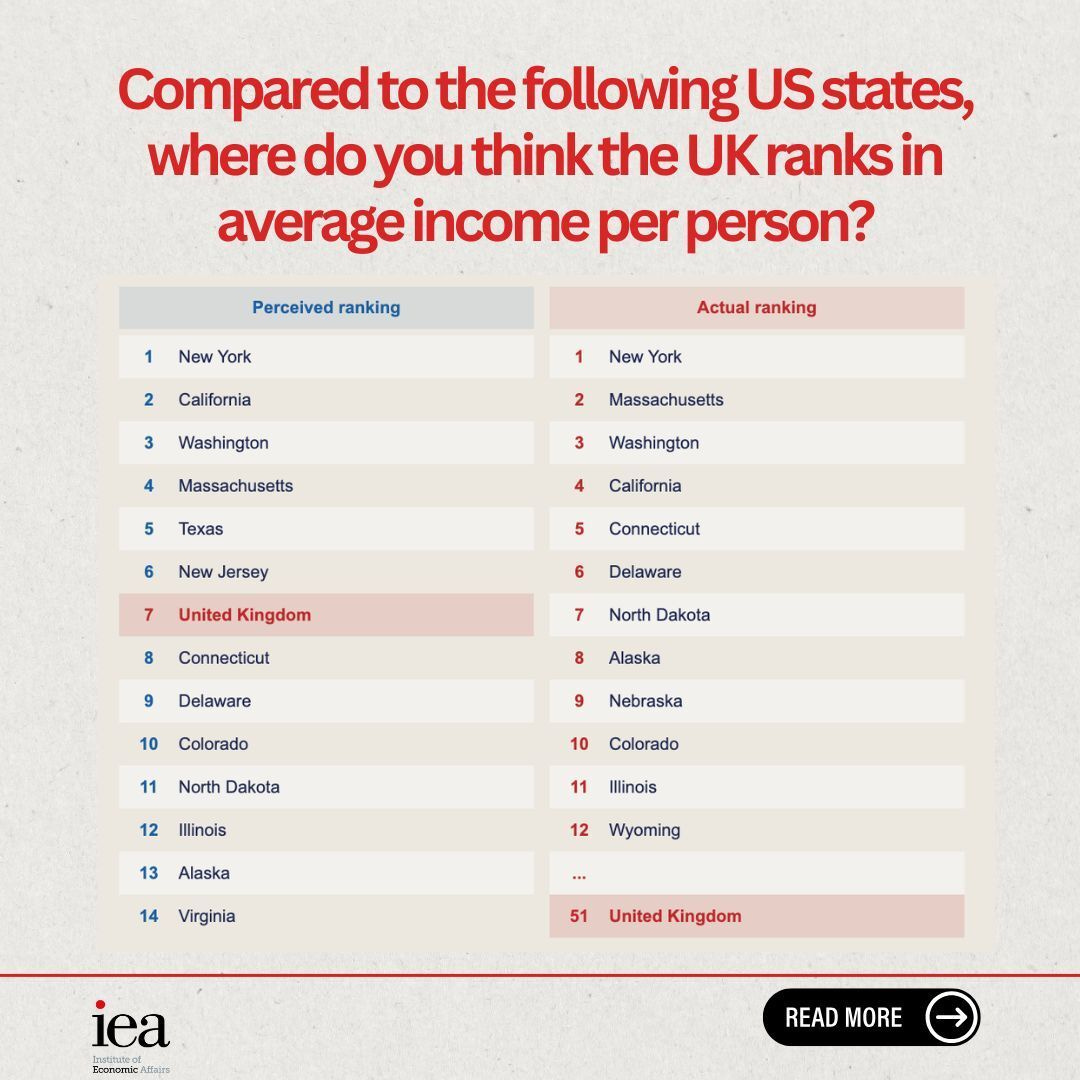
Via the Institute of Economic Affairs