

#56 State of Disarray
Plus: New smoking bans, paused pension plans, and 79 things to read about abundance
Welcome to the 56th instalment of the Liberal Digest. Not all that long ago, Sir Keir Starmer moaned that he’d go to pull a lever and nothing would happen. The maelstrom currently engulfing his government shows, at least some of the time, that is very much not the case. On his orders, Sir Olly Robbins, the top ranking official in the Foreign Office, unceremoniously and swiftly lost his job over perceived mishandling of Lord Mandleson’s appointment as Ambassador to the United States. The blowback has kept Westminster engrossed all week — possibly not the worst thing in the world for the Prime Minister if it keeps attention away from plummeting economic optimism and mounting political pressure ahead of the May elections.
Did we miss something? Let us know. On X? Give us a follow.
Stop the Press!
Best op eds, interviews, news and analysis of the week in the old-school media
Bagehot declares that Britain is not ungovernable, but it is currently ungoverned:
Frustration in Downing Street is understandable. Labour promised change. But it did not give itself the means to achieve it. Sir Keir’s government ruled out increases to income taxes or vat. Ignoring sensible tax rises meant having to choose more economically damaging ones. Sir Keir could do little to stop Mr Trump bombing Iran, but he could have stopped his own chancellor immediately hitting business with a tax on jobs. The tragedy is that he had the parliamentary tools to be bolder. Sir Keir won the second-biggest majority of the post-war era and squandered it. Cack-handed welfare reforms last summer sparked a humiliating rebellion, leaving the government unable to guarantee whether it could pass even tepid legislation. It took Sir Tony Blair eight years to reach such a point; Sir Keir managed it in one. Many, if not most, Labour mps think Sir Keir is a goner. Why try to win points with a prime minister who may not be there long? The meme that the British state is beyond repair predates Sir Keir. It started life in the Brexit years, a painful period mainly because politicians could not decide how they wanted to depart Europe. Once they did, Britain left swiftly. It was an immense effort—all in the name of making Britain slightly poorer. Better to blame bad execution rather than a terrible idea.”
Christian May warns that ministers urgently need to grapple with the economic crisis facing the country:
“Net economic optimism has been slumping since mid 2024 with the current gloomy sentiment consistent among all demographics surveyed by Ipsos. As the firm’s Senior Director Gideon Skinner put it: “dissatisfaction with the state of the country has been entrenched for some time.” It’s well understood that the war in Iran will hit – is hitting – the UK economy, as yesterday’s inflation data makes clear. The labour market is not in good health and we look set to endure another year of little to no growth. While it’s perfectly fair for ministers to bemoan the war’s impact it must also be acknowledged that the troubles from abroad come on top of major policy missteps at home, from record high tax burdens to damaging employment law reforms and a cavalier attitude to the ballooning welfare budget. Economists are warning of a recession and analysts fear for the fate of the Chancellor’s already thin fiscal headroom. The crisis might not be as obvious as it was in the winter of 1978 but it is no less real, and it will get worse.”
Will Hazell digs into whether Reform UK have hit their peak:
“While Farage’s friendship with the US President is not new and has always been looked on dimly by voters, O’Geran thinks it has become more corrosive to Reform because of the fresh cost of living squeeze unleashed by Trump’s attack on Iran. “The top reason people give for not voting for Reform is Nigel Farage’s connection to Trump,” he says. “It’s just become more and more toxic.” […] The Green Party of England and Wales may itself be partly responsible for Reform’s downturn. Zack Polanski’s party has risen inversely to Reform’s decline. In August 2025 – at Reform’s peak – the Greens were polling 9 per cent. Today they are on 16 per cent and contending with the Tories and Labour for second place. At first glance, it might seem surprising that the Greens could eat into Reform’s vote. But that overlooks two things – firstly, that voters are often relatively non-ideological, and secondly, that there are similarities between the appeal of the two parties. Hopkins says: “Both parties represent an ‘anti-Establishment, none of the above’ vote, right? They are two sides of the ‘not the Labour and the Tories’ coin. Neither Zack Polanski nor Nigel Farage would probably agree with this, but they represent the same thing on a really macro level, which is ‘the current system isn’t working – we have the alternative’. “So at that point for a voter, it’s just like, what flavour do you want your alternative to be? Voters are not as left or right driven as we think they are.””
Tim Worstall challenges the ‘logic’ of Gabriel Zucman’s latest broadside against billionaires:
“As the work of Mirrlees shows, a wealth tax is definitively rejected upon efficiency grounds. We like investment, thus taxing either the amount invested, or even the returns to investment is contraindicated. Money taken out to then consume becomes consumption or, to give it the other name, income, and that could be taxed as with all other incomes. This is how a general economic opinion has settled upon the progressive consumption tax as the best blend of that efficiency and equity we can achieve. All amounts invested, all made from having invested, is tax free, all used as income to be consumed is taxed at full whack – to give a pencil sketch of the idea. Another way to describe this would be that all investing is done in some giant self-invested personal pension, or 401(k) and only extractions from that are taxed as income at the usual progressive rates.”
Alex Chalmers outlines how Britain squandered its nuclear prowess:
“While the seeds of the backlash were being sown, nuclear licensing was becoming more conservative. In 1974, the government had consolidated workplace health and safety regulation into a single unified body, including sectors like nuclear power. The new Health and Safety Executive, which the Nuclear Installations Inspectorate joined, mandated that risk in the workplace be reduced ‘as low as reasonably practicable’ (ALARP). Crucially, the Health and Safety Executive was a nondepartmental body. The Ministry of Power had the clear objective of building new power stations. It wasn’t in the minister’s interests to rush approvals and build unsafe stations, but nor was it in their interests to endlessly postpone. The same dynamic is visible elsewhere: France, which undertook a vast nuclear construction program in the 1970s and 1980s, did not have an independent nuclear regulator until 2006, while in South Korea, which builds the developed world’s cheapest reactors, the prime minister’s office is heavily involved in nuclear regulation. When Britain made the licensing process independent, this link was broken. There was no longer an actor in the regulatory process incentivized to say yes.”
Plans to dictate how workers’ pensions are invested have been watered down:
“Torsten Bell, the pensions minister, had tried to push through the Pensions Scheme Bill with a clause that gave ministers the power to force funds to invest in UK infrastructure projects. However, the pensions industry demanded that the clause be cut from the legislation because of concerns that the money would be used to fund political “pet projects” such as HS2, and would mean that scheme trustees were forced to make investments that went against savers’ best interests.”
BBC News: Smoking ban for people born after 2008 in the UK agreed
Sky News: Facial recognition to be ‘rolled out’ across UK after human rights challenge fails
The Telegraph: Anti-Muslim influencer launches racist attack on Mahmood after being blocked from UK
The Guardian: Private health records of half a million Britons offered for sale on Chinese website
The Economist: A wave of antisemitic attacks in Britain reveals a new threat
Financial Times: UK public sector borrowing hit £12.6bn in March as Iran war strains finances

Stacks of Freedom
Highlights from our fellow Substackers
Michael Hill explains why cutting carbon taxes could actually help reduce emissions:
Noah Smith discusses the ambiguous debate that industrial policy is:

George Eaton penned the inaugural essay for Arguably:

Marian Tupy and Gale Pooley quantify progress in abundance:

James O’Malley argues that the Green Party is anything but:

Nisha Austin and Matt Clancy offer up no fewer than 79 things to read about abundance:

Wonk World
Ideas and analysis from the think tanks, academia and other clever sorts
Pedro Serôdio investigates the impact — or lack thereof — that artificial intelligence might be having on the labour market:
“In short, when it comes to employment, all specifications show broadly similar results: no clear signal in either direction. The estimates are noisy, the confidence intervals are wide, and neither measure produces a statistically distinguishable effect on aggregate employment. This is the main finding: three years after generative AI reached the market, there is no detectable employment effect for the most exposed occupations on UK data, regardless of which exposure metric is used.”
A new economic working paper suggests granting citizenship to children has a positive effect on crime…:
“We find that immigrant youth who acquired citizenship at birth are substantially less likely to engage in criminal activity, with estimates indicating a 70% reduction in crime. These results are particularly relevant in light of ongoing debates in the U.S. about abolishing birthright citizenship. Our findings suggest that inclusive citizenship policies can reduce crime and its associated costs, which in turn could strengthen social cohesion.”
… while another puts the doux commerce theory to the test:
“Empirical results demonstrate a strong “peace dividend” of international trade: that is, increased trade significantly reduces the probability and intensity of conflicts between nations. This effect remains robust across specifications and withstands a wide range of potential confounders. Such findings highlight how economic interdependence shapes international conflict—a relationship that is especially relevant amid escalating geopolitical tensions and the global shift toward “decoupling”, “de-risking”, and greater trade protectionism.”
Hear Hear
Podcasts for weekend listening
Ruxandra Teslo tells Works in Progress how we should reform clinical trials to make them more efficient and abundant:
Posting to Policy
Best of social media this week

Via Louis Mosley
Further Afield
Interesting stuff from around the world
Dean Ball discusses what the policy response should be to ever more capable artificial intelligence models:
“Mythos raises a vital question: should models this capable ever see the light of day, or should they remain under government control? Are these weapons, or the next big thing in consumer and enterprise software? The problem is that the answer is both. As such, “victory” in the global AI race means frontier AI will need to diffuse, rapidly, transforming the productivity of firms throughout the economy. Nationalisation of the frontier AI companies by the Pentagon or another government agency would restrict the very dynamism America and its allies need to stay ahead—not to mention the access to global pools of talent and capital, both of which could become harder for a government-run project. Would a “Manhattan Project” for AI really be able to employ foreign nationals, who currently populate as much as half of frontier-lab research staff? And would the American public, who already take a dim view of the construction of privately funded data centres, really be comfortable with hundreds of billions, if not trillions, of their tax dollars going directly to build data centres? It seems unlikely. A Food and Drug Administration-style licensing regime may be a bit lighter-touch, but the problem is scope. The range of risks posed by frontier AI, or indeed any general-purpose technology, is so broad that one struggles to imagine how a single licensing body could get its hands around them all. And what about political pressure from either the AI industry or anti-AI interest groups? A licensing regime is simply too deep a concentration of power over too fundamental and diffuse a technology to be sensible.”
The European Union approved a €90 billion loan and further sanctions on Russia, which had been previously been held up by opposition from former Hungarian Prime Minister Viktor Orbán:
“Although the funding was agreed last December, Hungary’s Viktor Orbán slapped a veto on the payment in February after Ukraine said damage caused by a Russian attack had brought supplies to a halt. Ukrainian oil and government sources told officials in Hungary and Slovakia that pumping had restarted, hours after the EU ambassadors began discussing the loan. Orbán had demanded the oil start flowing again before the loan could be paid out, and Ukraine confirmed the repairs had been completed on Tuesday. His election defeat last Sunday also cleared the air for the EU, bringing to an end his 16-year era as prime minister. Hungary’s next leader, Péter Magyar, has prioritised a reset in Budapest’s poor relations with Brussels. “Ukraine really needs this loan and it’s also a sign that Russia cannot outlast Ukraine,” EU foreign policy chief Kaja Kallas said ahead of the ambassadors’ meeting. The EU funding has been described by Ukrainian Deputy Prime Minister Taras Kachka as “a matter of life and death” for Kyiv, and two-thirds of it will be spent on bolstering Ukraine’s defence needs while the rest will go on broader financial assistance.”
BBC News: Court pauses redistricting in Virginia, day after voters approve new maps
The Economist: Wealthy New Yorkers grumble as a new tax looms over fortunes
Graph of the Week
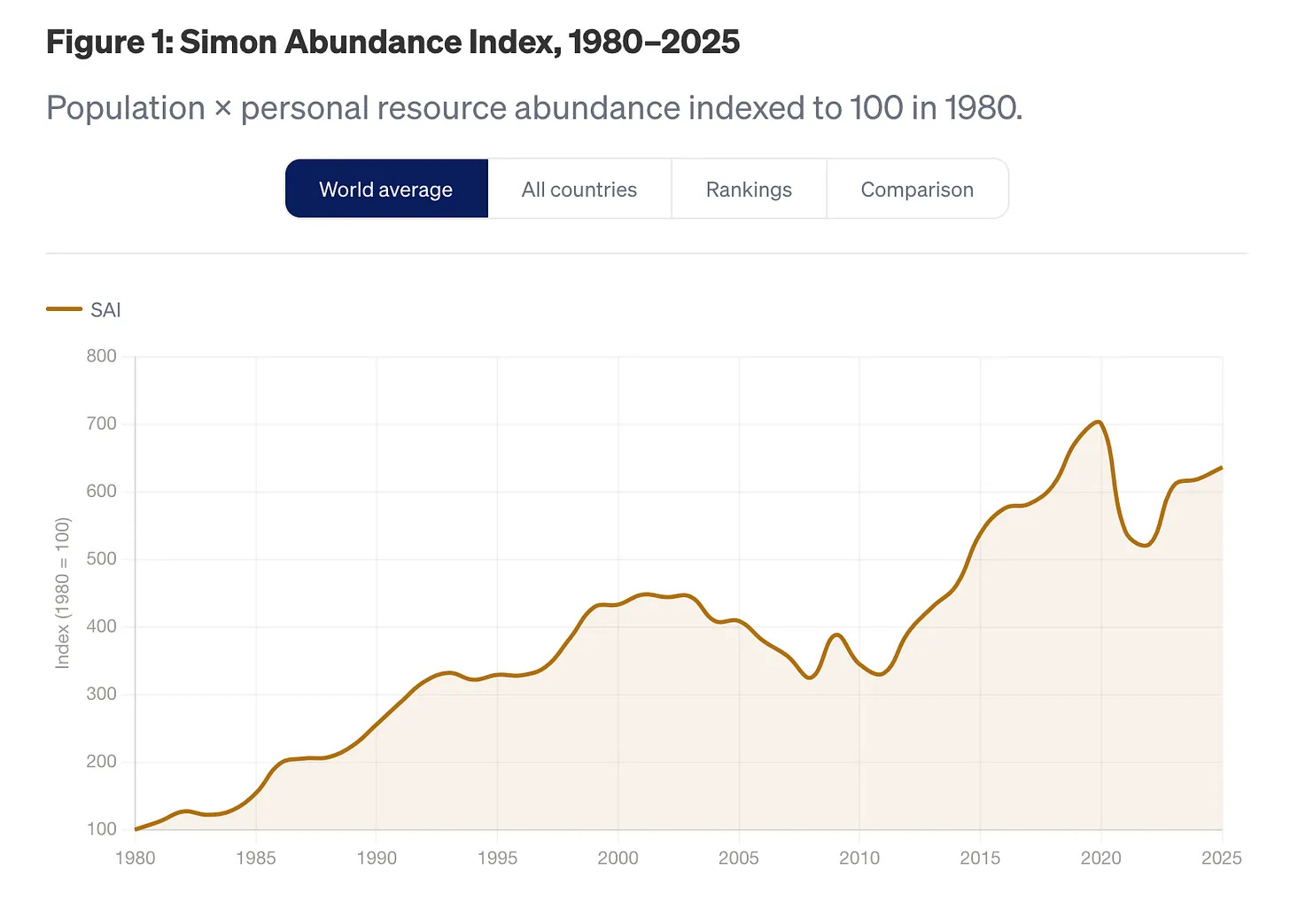
Via Human Progress