

#58 Ballot Dance
Plus: Technology truths, policing properly, and the case for a thicker political layer
Welcome to the 58th instalment of the Liberal Digest. The early results from the local elections are in, and so far it seems as though the demise of the two-party system is not being over-hyped. Labour have lost over 200 seats, many in what are often dubbed as their ‘heartlands’. Meanwhile, the Tories are down 80 and the Greens up more than 20 in the early counts, but the main story is predictably Reform who have so far gained over 300 seats. It really is early days in terms of results, and much focus will be on what happens in Scotland and Wales, but already questions are being asked of the viability of Sir Keir Starmer’s premiership. The questions that matter are whether this is a protest vote or something more permanent, what it tells us about people’s proclivities for tactical voting, and if Labour do kick out Keir, then what comes next?
Did we miss something? Let us know. On X? Give us a follow.
Stop the Press!
Best op eds, interviews, news and analysis of the week in the old-school media
Matthew Lesh goes in to bat for Palantir, arguing it provides an invaluable service to the NHS:
“Palantir is responsible for the NHS’s Federated Data Platform (FDP), which is connecting data across hospitals, trusts and care services and provides tools to improve planning, reduce waiting lists and help staff make better-informed decisions. It’s hardly particularly exciting stuff, but it is important. According to the NHS, the FDP has already improved scheduling efficiency in operating theatres, leading to 110,078 additional patients undergoing procedures. It has integrated hospital records with social care teams, reducing delayed discharges by 15.3 per cent. By linking cancer diagnostic, patient, and treatment systems, it has increased the rate of diagnosis within 28 days by 6.8 per cent. It has also reduced waiting lists by 797,728 patients. This clear success has not stopped Zack Polanski from calling for Palantir to “pack its bags and get the hell out of the NHS”. Nor did it prevent Faiza Shaheen of Tax Justice UK, sounding like an uninformed, petulant child on BBC Politics Live, arguing that the company cannot be trusted with patient data.”
Fred de Fossard discusses the twin threat of the Renters Rights Act and Employment Rights Act to Britain’s economic success:
“A flexible labour market and a flexible rental market are two fundamental components of a market economy. They are also vital for young people who want to start working and start building independent lives of their own. A meme has swept X called “Londonmaxxing” recently. In some respects, this is a charming online tribute to London as a place to live, to eat and drink, to innovate and to work. It has become especially popular among those who are bullish on London’s future AI economy. It is a nice idea. But if the people who make Londonmaxxing a reality cannot either find a job in the city or a room to rent, there will be nobody to max out what the city has to offer. The Employment Rights Act and the Renters Rights Act will erode the flexibility which makes economic activity and prosperity possible, and we will all pay the price. For some, the bill is arriving in their letterbox already.”
Tom Spencer critiques the argument that London’s housing crisis cannot be solved simply by building more homes:
“The studies this line of argument relies on measure what happens when new homes are added within a system that makes building extremely difficult. In such a system, increased demand produces little extra construction and mostly higher prices. Even a large addition of homes only takes the edge off. That is not evidence that supply is ineffective. It is evidence that the system is constraining it. It is like timing how long it takes to fill a bath with a thimble and concluding that baths cannot be filled. Of course the effect looks small. The real question is why we are using a thimble. Where building can respond, rising demand brings forth new supply and moderates prices. Where it cannot, the same demand appears as higher rents and land values. The responsiveness of supply is not fixed; it is determined by policy.”
Duncan Johnson argues that mandation was never the way to get pensions investing in venture capital:
“Whilst this final change will be celebrated by the wider pensions industry, I expect that the venture capital community’s reaction will be less enthusiastic. I, like the next VC investor in the UK, would like to see more pension money flow into our asset classes – it is how you go about achieving this result that is the contention. Back in the summer of 2025, 17 major pension providers voluntarily pledged to invest 10 per cent of their default funds in private markets by 2030, with half earmarked for the UK, in a move called the Mansion House Accord. Self-regulation and owning change are far better ways to evolve than to mandate, where accountability becomes an empty word. The most likely result of mandated investing is poor returns and a failure to generate the growth and next-generation economy we so clearly need.”
Joe Hill explains why we need an entirely new Civil Service Code:
“Rather than a list of things which the civil service values, it is a technical and legalistic statement of the long list of things that civil servants can’t do. It says precious little about the things that civil servants should do. So when the former Permanent Secretary says he acted in line with the Code, he means that he didn’t trip up on the constitutional principles of an impartial civil service – rather than that he was role-modelling any values which would help officials know what to do when dealing with challenging moral dilemmas. On these questions, the Code is silent, and the silence is deafening. The absence of a stated civil service culture doesn’t mean it doesn’t have one, it just means that we all pretend it doesn’t exist. Organisations have to organise by some principles, and the absence of positive ones means that Whitehall organises around negative ones – avoiding things. Avoiding taking risks, avoiding new ideas, avoiding bringing in people from the outside, avoiding getting rid of people who aren’t doing their job, and avoiding every elephant in the room.”
Ambrose Evans-Pritchard claims the Bank of England should follow the Federal Reserve’s lead:
“Nor do I envy the task of Andrew Bailey, the Bank’s Governor. Labour’s refusal to rein in runaway benefits or bite the bullet on taxation has pushed the country to the brink of a gilts crisis, with borrowing costs decoupling dangerously from G7 peers. He now has to manage the fallout from the Gulf just as Labour’s insular and self-indulgent Left hurls the nation into another round of political convulsions. The global bond markets will pounce at the slightest suspicion of fiscal dominance. Britain’s damaged credibility makes it nigh impossible for the Bank of England to take the lead in confronting New-Keynesian group-think and restoring classical orthodoxies. But the Federal Reserve can, and hopefully will, do the job for the rest of us.”
The Times reports that Sir Keir Starmer is expected to make a speech touting the merits of reintegrating with the European Union:
“Starmer will argue that the Iran war has demonstrated that Britain “cannot afford to ignore” the potential benefits of closer ties with Brussels. However, he will insist that his Brexit red lines, which state that there will be no return to free movement and that Britain will not rejoin the single market or customs union, will remain. The prime minister will come under mounting pressure in the wake of the elections to go further on relations with the EU in response to the party haemorrhaging votes to the Greens. Several cabinet ministers have privately advocated joining a customs union with the EU — something explicitly ruled out by Starmer.”
Financial Times: UK long-term borrowing costs hit highest level since 1998
The Guardian: Why is Reform UK threatening Green areas with migrant detention centres?
BBC News: Hate crime prosecutions to be fast-tracked after antisemitic attacks

Stacks of Freedom
Highlights from our fellow Substackers
Julia Willemyns outlines several potential changes to boost British state capacity:

Tim Leunig calls for ADUs to — at least partially — resolve the planning crisis:

Kelsey Piper argues it should be a liberal imperative to stop crime more effectively:

Neil O’Brien asks what happens when the go-getters get up and go:

Sam Dumitriu explains why dodgy forecasts about energy demand matter to us all:
Wonk World
Ideas and analysis from the think tanks, academia and other clever sorts
New evidence was published on the limited effects of school phone bans:
“Using a staggered difference-in-differences design, we find that pouch adoption substantially reduces phone use as measured by GPS pings and teacher reports. In the first year after adoption, disciplinary incidents increase and student subjective well-being falls, consistent with short-term disruption. However, effects on well-being become positive in later years and disciplinary effects fade. For academic achievement, average effects on test scores are consistently close to zero. High schools see modest positive effects, particularly in math, while middle schools see small negative effects. We find little evidence of effects on school attendance, self-reported classroom attention, or perceived online bullying.”
The Home Builders Federation laid bare the costs of increasing policy, tax, and regulatory pressures on house builders in Britain:
“The home building industry recognises that there is a legitimate policy rationale for many of these new or additional policy costs and taxes. However, in aggregate, they have imposed a significant cumulative cost burden on housing delivery, which is inevitably limiting the ability of developers to invest in new sites and threatening the housing pipeline. There should be a moratorium on further new policy costs, taxes and levies on home building, along with a comprehensive analysis of the unprecedented increase in policy costs imposed from across various government departments in the past few years. This moratorium should also involve the suspension of the introduction of the Building Safety Levy, currently planned by government for October 2026, that is set to add thousands of pounds of costs to the delivery of each new home.”
Hear Hear
Podcasts for weekend listening
Ezra Klein and Helena Rosenblatt discuss her new book The Lost History of Liberalism:
Posting to Policy
Best of social media this week


Via Eurofounder
Further Afield
Interesting stuff from around the world
Eli Stark-Elster wonders whether online worlds have become the last free places for children:
“Major public intellectuals and politicians have responded by arguing that children should rarely, if ever, participate in digital spaces. As a result, many schools in the US now demand that students seal their smartphones in magnetic pouches. A number of countries, including Australia, the United Kingdom and France, are even considering or have already implemented bans on social media accounts for children and teenagers. Such restrictions, however, are not the tools of liberation we may imagine them to be. In fact, for some children, the internet may be one of the last remaining spaces where they can grow up doing what children everywhere have evolved to do: independently play and explore with their peers.”
Financial Times: Hungary probes Orbán mogul for financial crimes
BBC News: Trump’s hopes for an Iran peace deal come with caveats
The Economist: The Supreme Court has unleashed the gerrymanderers
Graph of the Week
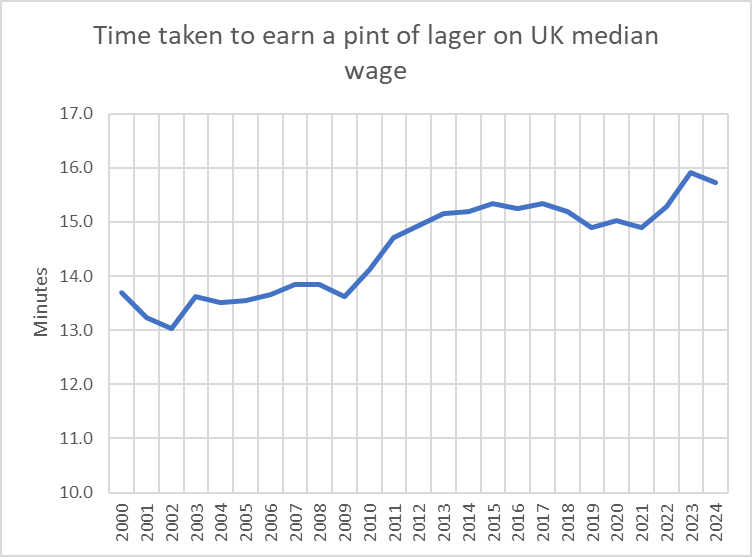
Via Daniel Freeman