

#67 Bin it Off
Plus: Wealth tax woes, a framework for free speech, and Burnham barrels on
Welcome to the 67th instalment of the Liberal Digest. The best (or worst?) of British politics was on display this week as Nigel Farage threw in the towel on being an MP temporarily in an attempt prove a point about something to do with the establishment(?), and has been left with a by-election in which his strongest opponent is a bin. Elsewhere, prominent wealth tax campaigner Gary Stevenson’s documentary, and promotion of it, made the mistake of exposing him to actual economists and tax experts. All the while, Andy Burnham continues to cruise towards 10 Downing Street unopposed while the detail of his plan for the country remains a bit of a mystery.
Did we miss something? Let us know. On X? Give us a follow.
Stop the Press!
Best op eds, interviews, news and analysis of the week in the old-school media
The Economist takes a dim view of Nigel Farage’s latest antics:
“That is not to say Reform has hit a ceiling. Plenty of voters hold views similar to Mr Farage’s and are dissatisfied with Labour and the Conservatives. His party continues to lead opinion polls and did well in the local elections in May. The political conditions for the populist right could improve, not least if Mr Burnham turns out to be a dud. But Mr Farage’s party has not expanded its appeal in the past year. Amid these challenges, a by-election in Clacton is not so much a show of defiance—as Mr Farage would portray it—as a retreat to his comfort zone. The populist leader would rather be pouring pints for a photo-op than poring over policy proposals. Playing ringmaster for the media circus comes more naturally than marshalling prospective ministers. There is every chance that Mr Farage wins Clacton (barring an unthinkable victory for Count Binface) while dashing his chances of becoming prime minister at the same time.”
How Britain’s dysfunctional system of social housing subsidies stymies growth:
“The system is also bad for growth. The subsidies are so big that they stop people moving for better-paid jobs elsewhere. Others are incentivised to cling to homes in city centres despite not working (over half of social-housing residents don’t work). The problem is acute in London, where the turnover of social housing is particularly low (around 3% a year), partly because the subsidies there are so high (see chart 2). With social housing making up nearly 40% of the stock in inner boroughs like Islington (see map), the result is a serious misallocation of the capital’s housing. Mr Burnham claims that new council homes will cut the benefits bill. But this holds only if they go to people on benefits who would otherwise be privately renting or homeless and in emergency shelter. Fewer than half of new social-housing tenants fitted that description in 2024-25. A quarter were previously living with friends and family. Housing them might be kind (living with one’s parents can be painful), but if it creates a fresh benefits claim, it will cost the exchequer more, not less.”
Lucy Mangan reckons wealth tax campaigner Gary Stevenson is shown up by his own documentary:
“...he is outdone and undone by almost all of his interviewees. Telecoms mogul Bassim Haidar, who was in the headlines last year for switching allegiance and donations from the Conservative party to Reform, does it through politeness. He invites Stevenson to address what he would do when his proposed tax caused investors like him to pull all their money out of the UK and find somewhere friendlier instead. Twenty-eighth generation landowner Francis Fulford (yes, of The F**king Fulfords and Life is Toff fame, but here in less eccentric mode) does it with robust jocularity (“The values you are basing your figures on will collapse! It’s Noddyland – it won’t work”) and inquiries as to how asset-rich but income-poor rich people like him will pay. Andrew Henderson of Nomad Capitalist, which advises clients on how to minimise their tax liabilities by moving countries, does it through sheer belligerence (“I don’t think life is fair and I think that fundamentally upsets people who talk about inequality because you feel entitled to rich people’s money”). Tax lawyer and adviser Dan Neidle deals the final blow towards the end of the programme by summing up the underlying problem of everything that has gone before. “You are unable,” he tells Stevenson coolly but firmly, “to separate your emotional reaction to inequality from a rational assessment of the best tools for it.”
Ministers are reportedly looking again at how to restrict cash payments for disability benefits as the spending bill soars:
“Pip claims for conditions such as anxiety, stress, ADHD have all more than doubled since 2021, compared with a 48 per cent rise overall. Psychiatric claims now make up 39 per cent of caseload. As a result, Britain will spend £32bn on Pip this financial year, a cost forecast to rise to £41.5bn at current prices by 2031. Spending on disability benefits — paid to compensate for extra costs of ill health whether or not someone is working — has doubled in real terms since 2009. With spending on incapacity benefits, paid to those judged too ill to work, also rising, it means total health-related welfare payments comfortably exceed spending on defence or schools. Working-age welfare costs, which fell to 4.3 per cent in 2019 after squeezes under the Conservatives, have risen back to 2015 levels of 5 per cent of GDP. Alarm at the rising cost of disability benefits led Sir Keir Starmer’s government last year to attempt to save £5bn by cutting eligibility for Pip. But a rebellion by Labour backbench MPs killed off the reforms and hastened Starmer’s political downfall. Andy Burnham, who is poised to replace him as prime minister this month, has said he wants to reduce the welfare bill without “crude cuts”. Claims are concentrated in the deprived post-industrial areas Burnham says he will prioritise. Wigan, where his own constituency sits, is one of dozens of areas where more than one in ten adults claim Pip. In much of the wealthy south-east of England, the rate is less than half that.”
Anna Ridgway argues that Andy Burnham could and should be the one to break the Triple Lock Taboo:
“Yes, this is politically risky. YouGov found in May that 66 per cent of the public support keeping the triple lock. Only 14 per cent oppose it. Landslide numbers. But dig into the detail and the picture shifts. When people are presented with specific alternatives, like a double lock or a smoothed earnings link, support and opposition split much more evenly. The British public might well accept change if anyone in politics actually tried to explain one. So far, nobody has. Westminster knows all this, by the way. As this site noted back in April, the triple lock is an open secret. Almost every economist, journalist, and politician privately accepts it is unsustainable. They keep it because older voters turn out, younger voters do not, and nobody wants to go first. That is not principle. It is cowardice dressed up as compassion. Burnham could break the pattern. Not by cutting pensions or punishing pensioners, but by swapping a volatile and badly designed indexation formula for a stable one, and being straight about why.”
Joe Dinnage lays out just how much of a technophobe our incoming Prime Minister will be:
“The Burnham regime looks set to focus instead on ‘tech sovereignty’ over partnerships with international firms. ‘We do need data centres, but we need to think about who runs and owns those data centres’, said a member of team Burnham. AI growth zones will also be reviewed. Regarding the planned rollout of driverless cars in London, one team member asked incredulously, ‘what’s the point and who’s it for?’ CapX readers will know that this resistance to tech does not bode well for Britain’s prospects. AI has the potential to transform the way we live for the better, and has already enhanced our public services, where politicians haven’t got in the way. Palantir’s work in the NHS is a case in point.”
GB News: Nigel Farage resigns as Clacton MP to trigger ‘people versus establishment by-election’
BBC News: TV licence fee is ‘yesterday’s model’, new BBC director general says
Financial Times: Labour MPs push for permanent ban on crypto political donations
The Guardian: Police investigate £500,000 Reform donations from mother of fraudster who backed Farage

Stacks of Freedom
Highlights from our fellow Substackers
Andy Masely discusses how liberalism and environmentalism should intersect:

Kristian Niemietz says Britain has decarbonised enough:

Noah Smith explains why JD Vance is wrong as ever to critique increasing GDP as a goal to aim for:

James O’Malley outlines a plan for how to avoid congestion in a robotaxi future:

Wonk World
Ideas and analysis from the think tanks, academia and other clever sorts
Jon Holbrook published a paper for the Prosperity Institute on how to bolster freedom of speech in Britain:
“When speech of a certain kind, dubbed “hateful”, is criminalised and the public sees ordinary folk being arrested, prosecuted, convicted, and imprisoned for things they have said, the culture changes. Conversation becomes cancellation and debate yields to denunciation. Society reaps what statute sows. This is not a problem caused by the judiciary. Judges do not make the law, they apply it. If they are required to enforce “speech crimes” they will do it, and moreover they will express justifications for doing it. That is their function in a democracy. Neither is this a problem that can be solved by appealing to judges in Strasbourg. The ECHR’s approach to hate crimes is far worse than it is in Britain. The answer to the UK’s free speech recession in a future Free Speech Act is simple. First, in criminal law, we must:
Repeal section 5 of the Public Order Act 1986.
Repeal three existing communications offences under the Malicious Communications Act 1988, the Communications Act 2003, and the Online Safety Act 2023, and replace them with one offence of communication that is intentionally menacing and targeted.
Repeal all so-called “hate speech” laws outlined in Table 1 of this paper.
Second, in civil law, we must:
Remove the protections for religion and belief from the Equality Act and replace them with a tort of unlawful interference with free speech.
Introduce a costs regime to protect those whose speech is interfered with and to deter interference in the first place.”
A new fund to support ideas and projects to promote British dynamism was launched:


Dan Neidle sets out why a British “passport tax” won’t work:


Hear Hear
Podcasts for weekend listening
Tyler Cowen interviewed Nobel Prize-winning economist Joel Mokyr:
Posting to Policy
Best of social media this week


Via Jeremy Horpedahl
Further Afield
Interesting stuff from around the world
Henry Donovan writes on how Germany seems to be faring as poorly if not worse than the UK when it comes to getting anything done:
“why does a country that still thinks of itself as Europe’s engine room seem to have lost the ability to fix its own bridges? It seems to be symptomatic for Germany’s current state. The country that once exported “Vorsprung durch Technik” to the world is now struggling to keep its own trains and bridges functioning – and its government is coming up with a reform package that doesn’t deserve to be called as such. Until Berlin’s political class stops treating that as an inconvenient footnote and starts treating it as the central story, the shrugging fatalism on Germany’s platforms and building sites will keep finding somewhere to go. And Germany will continue to fall apart quietly.”
Marine Le Pen declared she would run for president in the 2027 French election after an appeals court upheld her conviction for misusing EU funds:
“Le Pen was originally barred from public office on March 31, 2025, when a Paris court found her and other RN members guilty of embezzling European Parliament funds to pay the party’s staff in France, rather than the intended parliamentary assistants. The initial ban on her running for public office was for five years and, controversially, took effect immediately before any appeal could be heard. Speaking on French television on the evening of her conviction last year, Le Pen denounced the verdict as a “political” decision designed to keep her out of the 2027 race, calling it a “fateful day for our democracy. That initial ruling also triggered a furious response from her nationalist allies at home and abroad, feeding an anti-establishment narrative of an elite conspiring to shut them out.”
NATO leaders met in Turkey, where Donald Trump renewed his support for Article 5:
“An erratic and at times irascible Donald Trump has said he felt a “tremendous love” from western leaders at the Nato summit, only hours after lambasting them over their defence spending and not helping the US in attacking Iran. The US president’s mixed messaging dominated the final hours of the two-day gathering in Ankara, Turkey, beginning with him publicly calling Iran’s leadership scum and renewing his demand for control of Greenland. He then adopted a softer tone in a private meeting of 32 Nato leaders in the late morning, where he did not mention Greenland or other earlier criticisms, and instead told allies that “we want to remain with you”. “It was a great meeting, there was a lot of love in that room, a lot of unity,” Trump said soon after at a bilateral meeting with Ukraine’s Volodymyr Zelenskyy, which included a surprise offer to license the manufacturing of Patriot air defence missiles to Ukraine. Trump concluded by hosting a rambling press conference that barely addressed Nato topics, but where he praised Turkey’s strongman president, Recep Tayyip Erdoğan, talked up the US economy and said he was “No 1 on TikTok”.”
Reuters: Protests break out in Havana as Cuba struggles to restore electricity
Financial Times: Democrats race to salvage US Senate bid after Graham Platner scandal
The Guardian: LGBTQ+ cruise ship refused entry to Egypt days after Turkey turned it away
The Economist: Child suspects are being prosecuted at younger ages
Graph of the Week
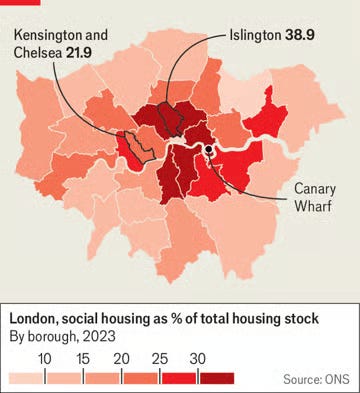
Via The Economist